Monday, November 11, 2013

Day 8- Google Map- Please Contribute! :) #edcmooc

Today I am learning how to make a Google Map which can be added to by 1,000 people. (I wonder...does that make it a wiki-map?)  When I asked for assistance, our very helpful TA, Ary Aranguiz gave me easy to follow, step-by-step instructions on how to create a map which we can all add our location to.  These directions AND the map link can be found pinned at the top of the Fb group page, #EDCMOOC. (Thank you, Ary!) 

Alternately, you can add your name and location and even a brief description of who you are to the map by following this link:

As of this writing we have 21 points on our map. I have embedded it here so we watch it grow.  You can also click on the [Full Screen] brackets to go to the map.


Imagine what it will look like with 1,000 points!  Also, you might want to check back from time to time, as it seems that since some of us are new at this, data occasionally "goes missing."  For example, last night when I viewed the map, I saw many more descriptions than I see this morning. :/  I'm not sure what happened (reminds me of a few of my students' wiki experiences!) but once you enter your data, check back in a couple of days and if any of your data is missing, please re-enter it. :)

Here are a few tips: 
To add a description and/or a picture, click on your name in the list and then click the pencil (edit) and add your information. To add a picture, TA Chris Swift provided these directions:  Here's how I did it - search for something on Google images, find an image you like, right click on it, and choose "open link in new tab". Your picture will open all by itself in a new tab. Copy that link and paste it into the bit for weblink within your pin's description - as below

If you need to edit your name as well,
Choose the data table:

And it gives you an easy form in which to input (or re-input) your information!

You can also change the color of your marker if you'd like. Let's have fun with this! (Go team?) :)


Saturday, November 9, 2013

Day 6 - Digital Culture (MACRO, NOT micro!!) #edcmooc

Last night I found the area of the discussion boards which contains the "Made By You" section and there I found the 60+ area.  Since I am not yet 60, I hesitated to click on the link, but having 30+ years of teaching under my belt I thought I might have something in common with these people so I clicked and was immediately glad that I did.  The first thing I saw was a post which voiced something that I have felt every since I started teaching online. It said, "Just turned 63 - it's difficult to believe. Am training in learning to teach online and completely resisting video. My self-image is still 33.....but then I look in the mirror..."

Personally, I have taught since I was 23 when my students seemed old to me...now they are younger than most of my children, and my self image is still in my mid-twenties. (I'm sure this has a place in our course under the umbrella of "digital culture!") But also in this 60+ discussion board was a video made by a classmate on her iPhone and it was so simply beautiful and un-self-conscious that I was inspired to "go for it" and make a video on MY iPhone.  

I want to address the point that when I signed up for this MOOC, I really expected something quite different.  The term "digital cultures," to me, had a more “micro” definition.  I thought we would be studying digital culture or even "community," as it applied to an online course or MOOC. Now, the MOOC we are currently taking has MUCH online community.  There’s a lot of interaction between the students, there's a lot of different ways that networking is occurring. There is a feeling here of connectedness--that’s more what I felt we would be studying--how it applies to a MOOC environment, but I was wrong.  This is a much more “macro” interpretation.  We are talking about digital culture as it applies to humanity as a whole.  Yet this too, is very interesting to me.  I have never really studied this academically. It’s been around me my whole life, of course, but I’ve never really looked at it from an academic perspective so I’m very excited by the contents of this course and after studying this academically, how I can apply this on a more “micro” level to my own online courses.

So here is my video summary of the first week of EDMOOC, wrinkles, under-eye bags, and 30+ years of student concerns (oh, and I don't sound like this in my head, either!!):


Thursday, November 7, 2013

Day 4 - Mooc Management 101 #edcmooc

Yesterday I had an epiphany. After the first two days of feeling like I "had to" do a certain amount of reading, checking posts, writing blogs, Tweeting--it hit me. Why? Who said I had to?   

A few things happened yesterday in my journey through the mooc which changed my reality. First, I wanted to include Adventures in MoocLand, by Alan Cohen, an edcmooc classmate in my blog. Only I wanted to ask his permission first and it was midnight in California and 3 am on the east coast where I figured he was from.  Check out his amazing cartoon! (Alan is the guy with the light bulb over his head in the YouTube video from my last blog post!) :)

http://Pixton.com/ic:yhvimh4q

So I gave myself permission to NOT write a blog post every day of this mooc. Having freed myself from the task of writing a blog yesterday, I really started digging into the Twitter feed rather than merely scanning it.  Here is what I learned:
  • Go Animate is an awesome resource which I now need to investigate further. While I found several wonderful examples in the Twitterfeed, this one tells why Fabover50 is taking this course:

  • There is an Diigo. (I had never heard of a Diigo before so, of course, I had to check it out!)  https://groups.diigo.com/group/e_learning-and-digital-cultures-2013 This site is chock-full of resources! I could spend days here...
  • There are as many outside sources of articles and opinions as you have time to absorb.  Again, I found myself "wandering" from one to the next.  
  • But the real catalyst of last night's epiphany was this Tweet:
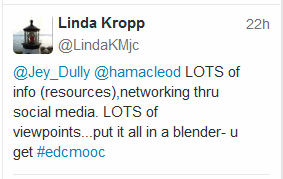
By now was midnight in California. It had been a long day.  I had read and learned a LOT in the mooc after a long day of teaching and other work "stuff." And then I saw this Tweet. Immediately the teacher/facilitator/even MOM wanted to jump in and respond, but I figured I am only two days more experienced than this person! Yes, I've replaced the egg on my Twitter account and I'm beginning to feel like I have a handle on what will work for me in this mooc, but there are many more experienced moocers abroad... And I thought I saw that other guy, @hamacleod on the course somewhere so maybe he would help. :) Twenty minutes later NOBODY had yet replied.  So I Tweeted back (and the teacher in me didn't think the first tweet was instructional enough):
This is when I realized that I really was starting to get a grip on things! :) And then I found this comment on my first day's blog and I knew that I finally had the right idea. 
 Thanks, Dr. Macleod :)

Tuesday, November 5, 2013

Day 2 - The 'Technological Imperative' #edcmooc

Today as I prepared to "work on" the MOOC, I felt that I should read the materials for the first week. At the same time I felt drawn to explore the Fb page, Twitter feed, and read up on what exactly a Google Circle is!

Feeling as though I should "practice what I preach," I read the required material for week 1, taking notes of thoughts and excerpts which tugged at my brain...more on those later.

When I finally allowed myself to go and play on the Twitter feed and blog feed, I was surprised to find that several of MY favorite bits were already commented on.  I've decided that's to be expected with 17,000 students and I will focus my blog on what I find relevant, even if it is not original.

This video which I found on a Fb post made by fellow MOOCer, Ary Aranguiz, was very insightful and ties in well with the whole concept of digital culture.  How true that we are often the last to see the value of our own contributions.


From the week 1 reading, here are a few quotes which caught my eye:

"A serious concern of the critics of technological determinism is that a belief in the autonomy of technology may deter those who feel helpless from intervening in technological development. The stance of technological autonomy could then be seen as something of a self-fulfilling prophecy."
-Daniel Chandler

I have long believed in self-fulfilling prophecy--the reason to never use negative discipline; the reason prisons are an abysmal failure.  But perhaps also the reason we have faculty who teach online yet feel slaves to the LMS which they are mandated to use. Discontent from being handed an endless stream of new expectations leads to a lack of involvement which results in disenfranchisement.  LMS Autonomy.

"Critics such as Henry Thoreau (d. 1862) noted that improvements in our technical means are no guarantee of improved ends, and may lead to a mechanistic and fatalistic outlook. He declared in his book, Walden, that 'we do not ride upon the railroad; it rides upon us.'"
-Daniel Chandler

Was this not written about distance education?? And the last quote from Chandler's work speaks for itself:

The Polish-American writer Isaac Bashevis Singer declared that,
'We have to believe in free will. We've got no choice.' 


Monday, November 4, 2013

Day 1 - already behind?! #edcmooc

So today was the first official day of my first ever MOOC (massive open online course). I thought I was ahead of the game because yesterday I found the Fb page and how to access the course, resurrected my Twitter account to Tweet about its upcoming start AND was re tweeted!

Today on course, I read about how NOT to become overwhelmed and to pick and choose what materials and conversations I feel most comfortable interacting with.  Awesome.  No pressure.  I'm liking the way this course is set up for me to gather and glean the knowledge I find most applicable to my teaching and learning style.

And then I started reading Tweets which were referring to how wonderful this video or that article was FROM WEEK TWO !!!  So much for "No Pressure!"  But then I realized that of the 17,000 people who are taking this course, perhaps some of them didn't have the commitments which I had today.  For me, getting my Twitter account set with the same password on my phone AND iPad, watching four videos (which did not portray technology in a very favorable light), and downloading the PDFs for week 1, was a tremendous start for day 1.

Oh,  and I started my first blog. (Something this digital immigrant NEVER aspired to do)